![Exploring Invertebrates: 10 Picture Books to Introduce Animal Characteristics [ep. 9]](https://www.naturallyteaching.com/wp-content/uploads/2024/07/exploring-invertebrates-books-header-300x200.png)
Science
Frogs and Toads Together: Why do Amphibians Group Up?April 11, 2025

An elementary teacher science blog
How are reptiles and amphibians different? That is a question that comes up with children (and adults) of all ages. They look similar, so aren’t they the same kinds of animals? Reptiles and amphibians have very distinct differences once you start investigating them closer, and that’s just what I’m proposing you do this May. And I’m here to help you get started!
In this episode, we’ll talk about activities to investigate how are reptiles and amphibians different that are paired with Next Generation Science Standards for grades 1st and 4th. I’ll share the standard that inspired the activity, how the activity relates to the question “how are reptiles and amphibians different?”, and descriptions of how to use the activity with your learners.
The following standards are paired with activities to learn about how are reptiles and amphibians different:
[0:00]
Teaching elementary-aged children is a rewarding experience, but as educators and parents, finding the time and resources to create engaging lessons can be a challenge. That's where this podcast comes in. Welcome to Naturally Teaching Elementary.
I'm Victoria Zablocki, a certified elementary teacher turned outdoor educator. With over a decade of experience coaching teachers on effective teaching methods, I'm passionate about teaching the whole child with authentic and place-based experiences in school and home settings. Join me as we explore our strategies for teaching with practical teaching tips, insightful interviews, picture book reviews, and more.
Let's grow together. Welcome back to the Naturally Teaching Elementary podcast. My name is Victoria Zablocki and I'm your host. If you listened to last week's episode, episode 69: Impact of Humans on Environment: Kindergarten and 3rd Grade NGSS Activities, you heard a couple of ideas for taking kindergartners and third graders outside to investigate how human impact affects amphibian and reptile populations. You also heard me remind you that May is a great month to investigate reptiles and amphibians as both groups of animals are awake from their winter sleep.
So to continue taking advantage of the emerging amphibians and reptiles, this week we'll focus on the difference between these two groups of animals in connection to first and fourth grade Next Generation Science Standards.
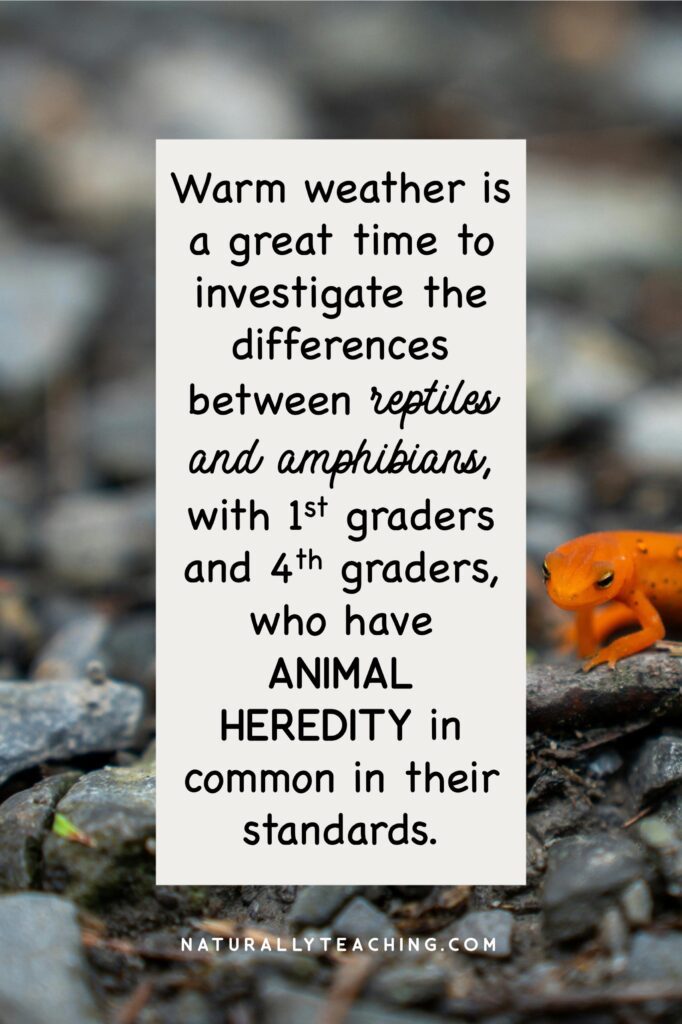
First and fourth grade standards have animal heredity in common, and now is a great time to help your learners sort out the differences between these seemingly similar animals. So in this episode, I'm going to describe activities to investigate how are reptiles and amphibians different for grades first and fourth. For each activity, I'll share the Next Generation Science Standard that inspired that activity as well as the scientific phenomenon that the activity helps explain.
Make sure that you listen through to the end of the episode, because even though I paired these activities to particular standards, you may find yourself inspired to use a similar concept for your curriculum or even use the same activity for a different grade. Also, if you're new to taking your students outside for learning, check out episode 6: 5 Outdoor Education Safety Tips for Teaching Outside, for suggestions to make teaching outside easier. Now let's get into these activities to explore how are reptiles and amphibians different.
[2:14]
For first grade, the Next Generation Science Standard that I pulled was 1-LS3-1: Make observations to construct an evidence-based account that young plants and animals are like, but not exactly like, their parents. For first grade, I would suggest a simple reptile and amphibian sort. Sorting characteristics is a good way to give your early childhood learners practice while also giving them the opportunity to find similarities and differences between these groups.
If you're personally feeling ill-equipped to introduce how are reptiles and amphibians different, go back to my podcast, episode number 7: Animal Characteristics Breakdown: Reaching Your Curricular Goals by Teaching with Animals. In that episode, I explain animal coverings, how the animals breathe, how they have young, if they're vertebrates or not, whether they're warm-blooded or cold-blooded, and something unique about mammals, birds, fish, reptiles, amphibians, and insects. If you want to skip to the reptiles, you can fast forward to 11:06, and if you want to skip ahead to amphibians, fast forward to 12:51.
Some tips for creating a sort for your learners. You'll want to make sure that you have equal number of characteristics to sort for amphibians and reptiles, and also complementary characteristics, so your learners can see how are reptiles and amphibians different and also the same. As an example, if you have scaly covering as a reptile characteristic, you should have moist skin for amphibians.
If you have eggs laid on land for reptiles, you should have eggs laid in water for amphibians. Some other characteristics you can include would be that they're both cold-blooded, they're both vertebrates with backbones, reptiles breathe with lungs, and many amphibians can breathe through their skin, and amphibians experience metamorphosis while reptiles do not.
If you like the sounds of this activity, but you feel like you don't have the time to put it together, check out my Reptile and Amphibian Characteristics sort on Teachers Pay Teachers. It includes how are reptiles and amphibians different through pictures and simple words for early readers. Your early childhood learners can work on fine motor skill development with scissors to cut out the pictures and glue to paste them onto a graphic organizer, either a reptile and amphibian table, or into a reptile or amphibian bubble chart. There's also a black and white copy, a color copy, and teacher answer keys.
Parissa G said, “This resource was exactly what I needed for my STEAM class. It was clear, engaging, and easy to implement. My students were excited and totally bought in, and I appreciated how it saved me time while still being high quality. Definitely a great addition to my teaching toolkit.” Thank you, Parissa, for your kind words. If you're interested in taking a peek, you can follow the link in the show notes.
[4:46]
The fourth-grade Next Generation Science Standard that I pulled was 4-LS1-1: Construct an argument that plants and animals have internal and external structures that function to support survival, growth, behavior, and reproduction. For fourth grade, I've got a really exciting and engaging game this week. Last week, I had games too, but this one is over the top.
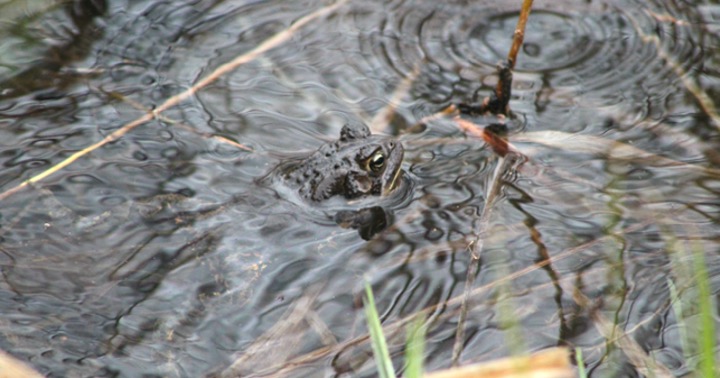
Kids of all ages love to play Hide and Seek, but we're going to ramp it up a bit. So reptiles and amphibians are well known for their coloration, and many herps have colors that help them camouflage into their ecosystems. Wood frogs are brown and blend in well with the forest floor.
Green frogs are green and blend in well with lily pads on ponds. Snapping turtles are dark gray and green and blend in well with their pond water. However, some herps have bright colors to distract predators, like painted turtles that have yellow dots on their heads to look like eyes underwater to scare off predators, or five-lined skink young which have bright blue tails that attract predators that they can then drop the tails and scurry away while the predator is busy.
So take these characteristics and apply them to a game of hide and seek. Spend some time studying the external colorations of reptiles and amphibians with your learners. You could read about frogs, toads, salamanders, turtles, lizards, snakes and more, and how they use their colors to survive, focusing on camouflage and how it helps animals avoid predation.
Once your learners have discovered the advantages of different animals' coloration, challenge your learners to dress for an intense game of hide-and-seek. Before you play, you want to take your learners out to the play area. You'll want to find a spot that has a variety of things to hide behind, in, and around.
Forested areas are always great. Fields with tall grasses can be fun, and edges between fields and forests can work well too. After your learners have investigated the hide-and-seek play area, set the date and have your learners dress to blend into the environment.
Also have them bring one clothing item that is very bright, that does not blend into the environment, that they can either put on over top of their clothes, or wear under their clothes that they could expose for a subsequent round. On the day of hide-and-seek, go out to the play area and set the boundaries. Use natural boundaries such as fences, big trees, sidewalks, logs, etc.
Or mark the area with brightly colored ribbons around tall objects. After you remind your learners about the boundaries, select one person to seek and then have them count to 60. You want to give your learners plenty of time to hide.
This first round will be the camouflage round. They want to blend in as best as possible. You the educator will time the round and see how long it takes for the seeker to find everyone.
When they find someone, you can have those learners return to a spot near you so that you can keep track of everyone before the next round. Once everyone is found, you can switch out the seeker for someone new and have your learners play with their bright color exposed. Have them re-hide and have the seeker count to 60.
Then, time this round to see how it compares to the round where all of your learners could blend in easily. When learners are found, they return to you just as they did previously. After both rounds are complete, have a conversation about how long it took for the seekers to find them.
Did they get found easier with their bright color or the camouflage colors? Why did they think that? What would be the benefit of having a bright color if you're a reptile or amphibian?
After they've played, talk about some of the reptiles and amphibians that use bright colors to their advantage. Investigate some of the outliers that have bright colors and what those can actually do for an animal's survival. It's a great experience to bring to life why animal coloration can be key to animal survival. Plus, it's a whole lot of fun!
[8:14]
In a nutshell, today we talked about activities for first and fourth grade and how they help answer the question how are reptiles and amphibians different? For first grade, we talked about a reptile and amphibian characteristic sort.
For fourth grade, we talked about a camouflage hide and seek game. Don't forget, if you're looking for a made for you, reptile and amphibian sort, check out my reptile and amphibian characteristics or on Teachers Pay Teachers. Thanks for taking time to listen today.
I know you're busy and I truly appreciate the time you take to tune in. If you have any questions, wonderings or activities to investigate how are reptiles and amphibians different that you use, get a hold of me on Instagram at Naturally.Teaching, or you can email me at victoria@naturallyteaching.com. Don't forget to check out the show notes for this episode at naturallyteaching.com/episode70 for all the links that I mentioned.
So thanks again for joining me today, and until next time, keep exploring, keep learning, and keep naturally teaching. Thank you so much for tuning in to today's episode of the Naturally Teaching Elementary Podcast. I hope you found it informative, inspiring, and full of actionable insights to enhance your teaching journey.
Connect with me on social media for more updates, science tidbits, and additional resources. You can find me on Instagram and Facebook at naturally.teaching. Let's continue the conversation and share our passion for teaching elementary-aged children together.
Don't forget to visit my website at naturallyteaching.com for all the show notes from today's episode. If you enjoyed today's episode, please consider leaving a review on your favorite podcast platform. Your feedback helps me improve and reach more educators like you.
Thank you again for listening, and until next time, keep exploring, keep learning, and keep naturally teaching.

0