![Exploring Invertebrates: 10 Picture Books to Introduce Animal Characteristics [ep. 9]](https://www.naturallyteaching.com/wp-content/uploads/2024/07/exploring-invertebrates-books-header-300x200.png)
![Learning Gardens: Creating Dynamic Outdoor Classrooms with Victoria Hackett [ep. 8]](https://www.naturallyteaching.com/wp-content/uploads/2024/07/learning-gardens-header-300x200.png)
Science
Frogs and Toads Together: Why do Amphibians Group Up?April 11, 2025

An elementary teacher science blog
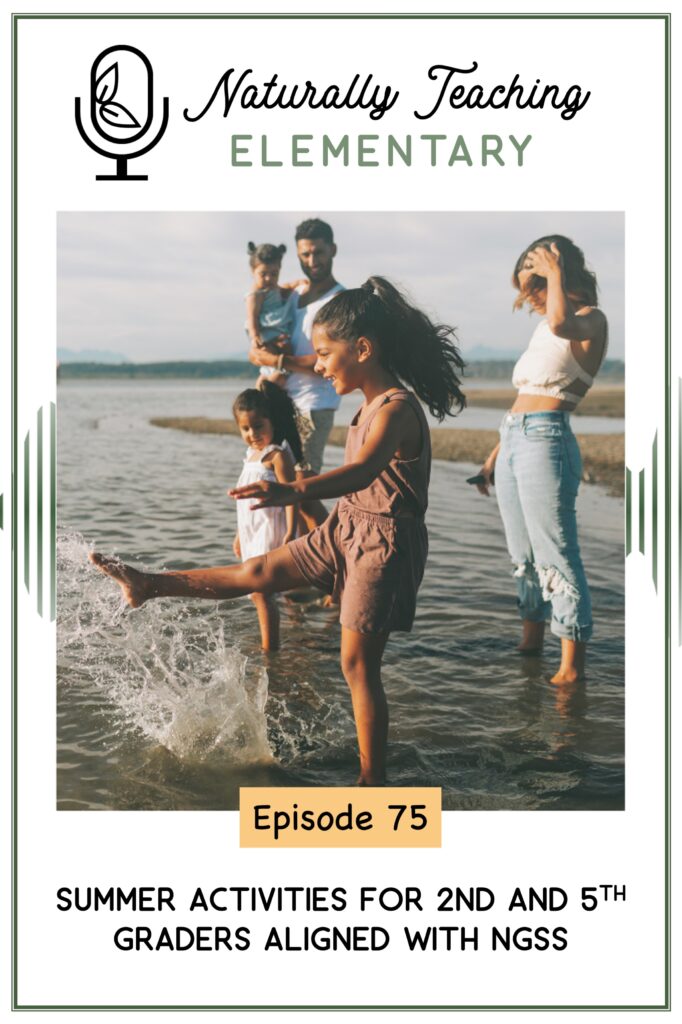
It’s officially summer! And with it is a wonderful opportunity to explore water and where it can be found. Now is a great time to suggest to your learners’ caregivers to enjoy the local waterways and help prevent that summer slide.
In this episode, we’ll talk about summer activities that are paired with Next Generation Science Standards for grades 2nd and 5th. I’ll share the standard that inspired the activity, how the activity relates to water, and and how you can share those activities with your learners’ families.
The following standards are paired with summer activities:
[0:00]
Teaching elementary-aged children is a rewarding experience, but as educators and parents, finding the time and resources to create engaging lessons can be a challenge.
That's where this podcast comes in. Welcome to Naturally Teaching Elementary. I'm Victoria Zablocki, a certified elementary teacher turned outdoor educator.
With over a decade of experience coaching teachers on effective teaching methods, I'm passionate about teaching the whole child with authentic and place-based experiences in school and home settings.
Join me as we explore strategies for teaching with practical teaching tips, insightful interviews, picture book reviews, and more. So let's grow together.
Hey everybody, welcome back to the Naturally Teaching Elementary podcast. My name is Victoria Zablocki, and I'm your host.
So if you listened to last week's episode, episode 74: Outside Summer Activities for 1st and 4th graders Aligned with Next Generation science Standards, you heard a couple ideas to introduce outside summer activities to 1st and 4th graders and their families.
This week, we'll continue the theme of summer and all its glory, but more specifically, we'll focus on summer water in connection to 2nd and 5th grade Next Generation Science Standards.
So 2nd and 5th grade standards have water and where it's found in common, and summer is a fantastic time for your learners and their families to enjoy water together. So in this episode, I'm going to describe summer activities for grades 2nd and 5th.
For each activity, I'll share the Next Generation Science Standard that inspired that activity, as well as how you can share that activity with your learners' caregivers to practice over the break.
And make sure that you listen through to the end of the episode, because even though I've paired these activities to particular standards, you may find yourself inspired to use a similar concept for your curriculum or even use the same activity for a different grade.
Also, if you're new to taking your students outside for learning, check out episode 6: 5 Outdoor Education Safety Tips for Teaching Outside for suggestions to make teaching outside easier. Now let's get into these summer activities.
[1:57]
For 2nd grade, the Next Generation Science Standard that I pulled was 2-ESS2-3: Obtain information to identify where water is found on earth and that it can be solid or liquid.
So for 2nd grade, I would suggest encouraging your families to take advantage of their time together to investigate different places around them where water can be found. Water is a very important aspect of all of our lives, and not just for drinking.
It is one of the most alluring loose parts that children can have access to at any age, but especially in early childhood, where they develop their problem-solving skills, their imagination, their social-emotional skills, their motor skills, and more.
So for this activity, encourage your families to start a list of areas that they visit this summer where they found natural water.
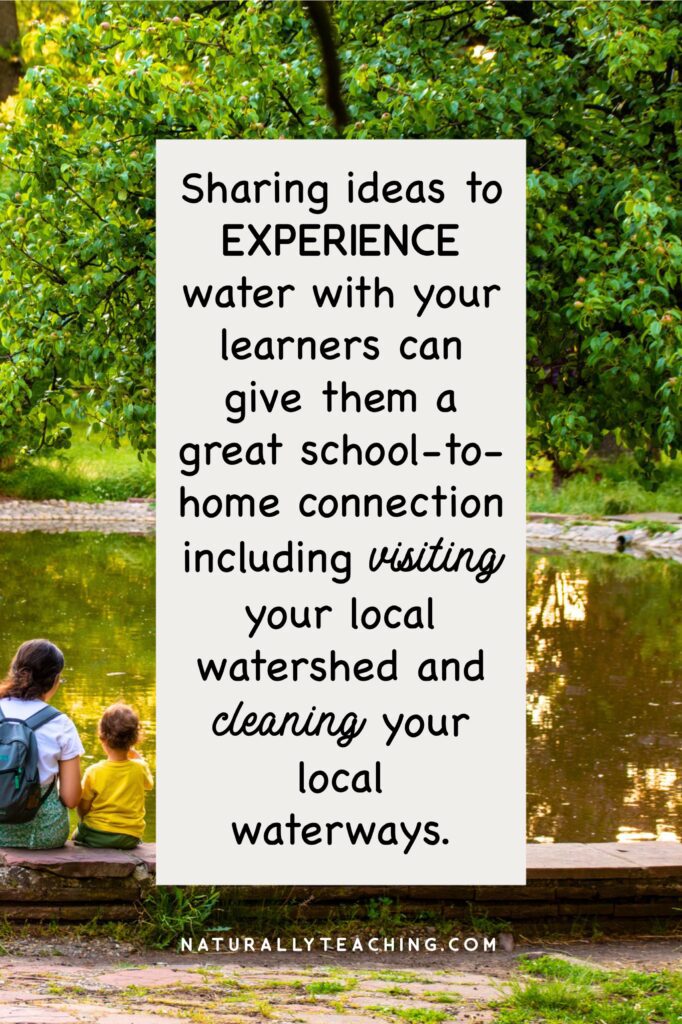
Since families are able to travel easier during the summer than classes can during the school year, now is a great time for your learners to explore your local watershed or even more distant waters if your families are traveling this summer.
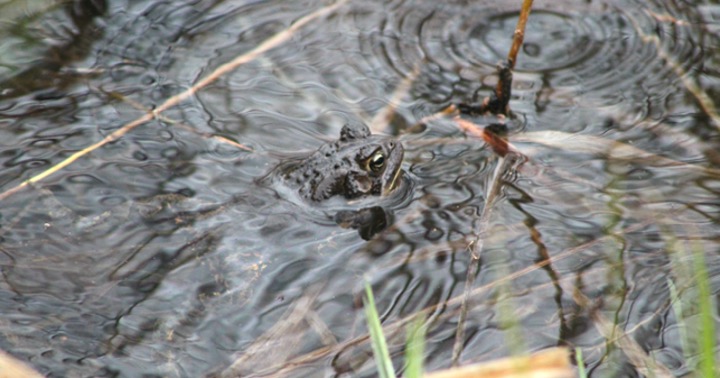
It may help to inspire your families if you give them a list of places that water can typically be found, such as oceans, lakes, rivers, ponds, wetlands, springs, caves, and glaciers. Once they have your list of suggestions, they can visit the water and enjoy it together.
If they want, they could draw a picture of each of the different types of water and make notes on what they find, but this activity is a suggestion to get them immersed in nature and naturally discovering where water is on earth. They can add or omit whatever activities they'd like.
One of the best ways to solidify the learning of concepts is to provide an experience that creates memories, and your learners will do just that with their families this summer.
[3:36]
For fifth grade, I actually picked two standards.
So the first one is 5-ESS2-2: Describe and graph the amounts and percentages of water and fresh water in various reservoirs to provide evidence about the distribution of water on earth. And the other Next Generation Science Standard that I pulled for fifth grade was 5-ESS3-1: Obtain and combine information about ways individual communities use science ideas to protect the earth's resources and environment.
So for fifth grade, I would suggest encouraging your families get involved in a waterway cleanup. After spending all year learning about water, where it's found, and how precious of a resource it is, your kiddos will likely understand the value of getting involved to help protect your local waterways.
This is something that your families could do on their own, or they can try to locate an organized cleanup to join.
If your families are looking for more of an organized effort, they can check their local nature center, parks and rec department, state or national parks, conservancies, and more. Many of these organizations embark on these specific conservation efforts during the summer when the water is lower, slower, and warmer.
If your families are more interested in doing this by themselves, there are a few things to suggest to make sure that they are successful but also safe. So first, they should select a waterway that is part of a public property or is part of their own private property.
Although they're trying to provide a service to better the community, they still need to respect people's private property. Technically, here in Michigan, the rivers are public property when you're floating, but it gets muddy if you step out of a boat and onto the riverbed or bank, which could be privately owned.
Your families should also make sure that they're protected from possible contaminants in the water. To do so, they should check local water surveying to see what the contaminant levels are and if it's safe to be in the water.
They should also locate easy access areas to enter and exit the water. They should look for stable ground with low incline, and they should avoid steep, unstable options like high riverbanks.
If your families plan to be in the water, they should also make sure to wear bright colors and flotation devices, just in case they fall into the water and need rescue efforts.
Your family should also make sure that they know what's safe to pick up and what's not. They should avoid broken glass, medical waste, rusted metal, or hazardous materials.
If they don't have the knowledge to stay safe with the item, they can use flags or something else to mark them, and then they can call waste disposal or authorities depending on the hazard of the object.
Some other considerations your family should think about would be how they plan to dispose of the waste. Are they going to bring heavy-duty trash bags, or are they going to add it to a park dumpster? The job isn't done when the items are removed from the water. They then need to be disposed of in the proper way.
What does the weather look like that day? Doing a water cleanup in rain is a risky idea because the rain can make banks slippery, and flash flooding is a hazard on heavy rain days.
What are they wearing to do the job? If they're wearing waterproof boots for the job, they should make sure to clean them with hot water before and after entering the waterway to ensure that invasive species don't get spread.
And how sensitive is the waterway? If it's a space with a lot of specialized species, it could be good to have the guidance of a professional, or they should possibly select a different location.
Although this setup sounds like a lot, it's mostly the planning part that takes forethought and time, but once they've got a plan, the rest is stewardship.
Fifth graders are old enough that they can take pride in serving, and this is a great opportunity to review their curriculum to help prevent that summer slide, but also take action to help the community and science.
[7:12]
So in a nutshell, today we talked about summer activities for 2nd and 5th grade that you can share with your learner's caregivers to help prevent summer slide.
For 2nd grade, we talked about visiting different parts of your local watershed to experience where water can be found. And for 5th grade, we talked about cleaning up local waterways.
So I want to thank you for taking time to listen today. I know you're busy and I truly appreciate the time you take to tune in.
If you have any questions, wonderings, or summer activities that you suggest to your learner's caregivers, get ahold of me on Instagram at naturally.teaching, or you can email me at victoria@naturallyteaching.com.
And don't forget to check out the show notes for this episode at naturallyteaching.com/episode75. So thanks again for joining me today, and until next time, keep exploring, keep learning, and keep naturally teaching.
Thank you so much for tuning in to today's episode of the Naturally Teaching Elementary Podcast. I hope you found it informative, inspiring, and full of actionable insights to enhance your teaching journey.
Connect with me on social media for more updates, science tidbits, and additional resources. You can find me on Instagram and Facebook at naturally.teaching.
Let's continue the conversation and share our passion for teaching elementary-aged children together. Don't forget to visit my website at naturallyteaching.com for all the show notes from today's episode.
If you enjoyed today's episode, please consider leaving a review on your favorite podcast platform. Your feedback helps me improve and reach more educators like you. Thank you again for listening, and until next time, keep exploring, keep learning, and keep naturally teaching.

0